Free readability assessment tools to help you write for your readers
Reading Levels | Grade Levels | Word Usage | Reader Profiles

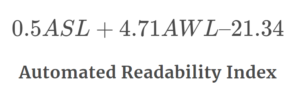
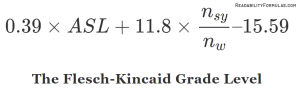
You can use “readability formulas” to measure the difficulty of words and sentences in any written materials. You can choose from several dozen readability formulas, including the Fry formula, SMOG, Dale-Chall Formula, and Flesch tests (Flesch-Kincaid and Flesch Reading Ease). Because readability formulas vary in purpose and calculation, most writers use no more than three similar formulas on a document. These formulas estimate text difficulty based on the length of words and sentences. All readability formulas output a result equivalent to a grade level, such as “fourth grade” or “12th grade.”
The examples below will help you better understand how word choices and sentence length can affect ease of reading. Paragraphs A, B, and C each show similar content written at three different grade levels. Can you guess the grade levels? Notice how each example varies in vocabulary and sentence length .
What grade level do you think it is?
Paragraph A
“It makes good sense that premature births and newborn illnesses are decreased by early pregnancy care. doctor is actively involved in testing pregnant woman for induced diabetes host other problems would not be detected patient alone. We know that these problems cause premature births and illness in newborns. It certainly makes sense that earlier detection and of these problems by the doctor results healthier babies.”
Paragraph B
“If you are pregnant or think you may be pregnant, call for an appointment right away. Getting care early in your pregnancy will help have a healthy pregnancy and a healthy baby. Your PCP (or an OB-GYN doctor you choose from your network) will give you certain tests to make sure everything is going well. If there are any problems, it’s good find them early. That way, you have the best chances for a healthy baby.”
Paragraph C
“If you are pregnant or think you might be, go to the doctor as soon as you can. If you start your care early, things will be better for you and your baby. Your own doctor or childbirth doctor from our list will give you a first exam. Testing every month will let you know if all is going well. If there is a certain problem, you’ll know it right away. Then we can do what is needed. Early care is the best way to have a healthy child. Your baby counts on you.”
Answer: Approximate grade levels are:
Dr. Peter Mark Roget, creator of the famed thesaurus, once remarked, “The choice of words and the elegance of expressions are the essence of effective communication,” highlighting the importance of vocabulary in readability.

Be cautious when you use readability formulas.
Readability formulas ignore other factors that score the ease of reading and comprehension, including the active role of the reader. Relying on a grade level score can mislead you into believing that readers can read and understand your materials—when, in fact, they cannot.
“The average adult can read a text with a Flesch Reading Ease score of 70-80,” suggesting that writers need to target their content appropriately for the intended audience’s reading capabilities.
Enforcing a grade level requirement has the potential to do harm. To make text scores at a lower grade level, you need to shorten words and sentences. Sometimes this improves ease of reading, but it can also lead to edits that reduce the ease of reading. For example, writers might remove familiar words just because they are long. Overall, writers may produce choppy text that lacks cohesion because they want to meet a specific grade level.
A Nielsen Norman Group report found that cutting down the word count of web content by half made the text 58% more readable for online readers.

More writing advice:
—END—