Free readability assessment tools to help you write for your readers
Reading Levels | Grade Levels | Word Usage | Reader Profiles
FORCAST Readability Formula is the only formula not designed for running narrative or connected text. It counts syllables instead of familiar words and ignores sentence length. This focus makes it appropriate for texts that don’t have full sentence stops or the usual paragraph format. Therefore, you can apply it on multiple-choice quizzes, applications, instructional texts, entrance forms, technical manuals, and so on. FORCAST is suited to score texts above primary age reading materials, from 5th grade to college. (You can score your text using our free FORCAST Readability Calculator.)
The development of FORCAST is historically noteworthy. In the early 1970s, as the draft called thousands to serve during the Vietnam War, the U.S. Army faced a literacy challenge: many fresh-faced recruits struggled with basic reading. Military manuals and directives might as well have been written in code. It was an issue that, if left unaddressed, threatened to weaken the very fabric of the military’s operational effectiveness.
The Human Resources Research Organization assigned linguists J. Patrick Ford, John S. Caylor, and Thomas G. Sticht to study the reading requirements of military occupational specialties (MOS). Their subjects were Vietnam draftees entering basic training and job-specific military roles. The FORCAST (FORd, CAylor, STicht) formula evolved from their research. The formula, first introduced in 1973, could evaluate how complex reading materials were for different military roles, helping HR place recruits in positions that best suited their reading skills.
A few years later, in one of his famous “fireside chats,” President Carter pushed for clearer government documents, especially in the military where understanding the written word is vital. If people can’t understand regulations and directives, this confusion can waste resources and harm safety and morale. Reacting to President Carter’s call, the Air Force decided to reduce their publications and make the remaining ones easier to read.
They set out to:
Because of its ease of use and accuracy (especially on technical materials), the Air Force approved using the FORCAST formula on all of their publications.
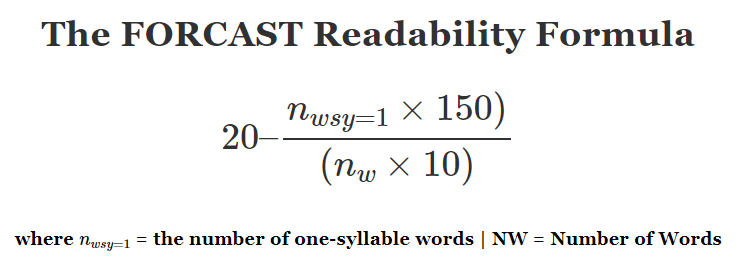
where \(n_{wsy=1}\) = the number of one-syllable words | NW = Number of Words
Step 1: Select a sample text 150 words or more.
Step 2: Count NWS (the number of single-syllable words) and multiply by 150.
Step 3: Multiply the total number of words by 10.
Step 4: Divide total # of single-syllable words by total # of words.
Step 5: Subtract the result obtained in Step 4 from 20.
The final result is the Grade Level.
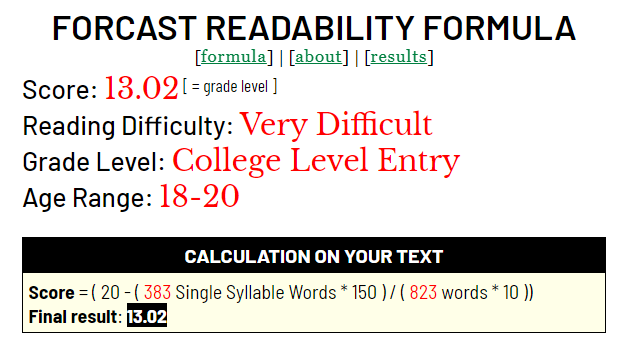
EXAMPLE:
Number of Single Syllable Words = 120
Total Number of Words = 232
Let’s plug these values into the formula to calculate the readability score.
Step 1: 20 − (120 × 150) / 232 × 10)
Step 2: 20 − (18000 / 2320 )
Step 3: 20 − (7.7586)
Step 4: GRADE LEVEL = 12.24 (12th Grade)
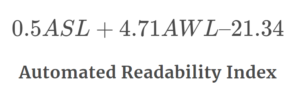
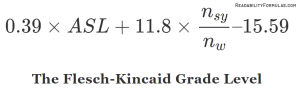
FORCAST complements other readability formulas by filling a gap for a specific type of text; other formulas like Flesch-Kincaid or Dale-Chall do not score as accurately on non-narrative texts.