Free readability assessment tools to help you write for your readers
Reading Levels | Grade Levels | Word Usage | Reader Profiles
In the art of writing, it is vital to weave words that resonate with your readers. Your aim is for crystal-clear clarity, whether you’re penning a book, drafting an article, or developing educational content. You want your readers to grasp your message without confusion or difficulty. That’s where the Spache Readability Formula comes in—a handy tool to gauge the complexity of your text and make it more reader-friendly and reader-focused.
The Spache formula was developed by Dr. George Spache in the 1950s. He first introduced his formula in 1953 in an article, A New Readability Formula for Primary-Grade Reading Materials, published in The Elementary School Journal. The formula calculates the grade level of a text based on sentence length and unfamiliar words. “Unfamiliar words” are words that students in 4th grade and below do not recognize.
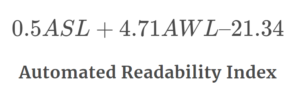
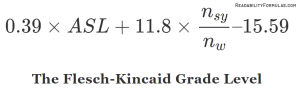
The Spache formula is similar to other ones, such as the Flesch-Kincaid Grade Level, but it uses the Spache Word List, a set of specific words that young readers often find familiar. The word list progresses from basic words to more complex ones, aiding in gradual learning and understanding. Educators use it as a helpful tool in early literacy instruction.
The formula also considers average sentence length. Shorter sentences make texts more easily readable, especially to young readers, while longer ones can contribute to text complexity.
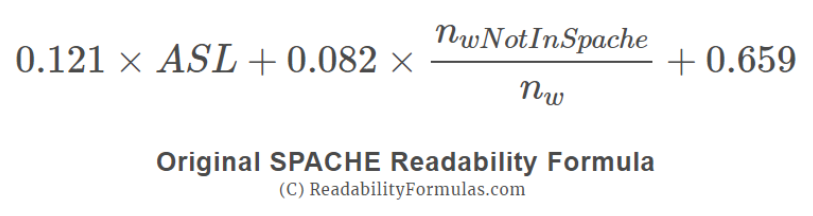
The Spache formula is as follows:
(C) ReadabilityFormulas.com
Where ASL = Average Sentence Length | nwNotInSpache = # of difficult words | NW = total number of words
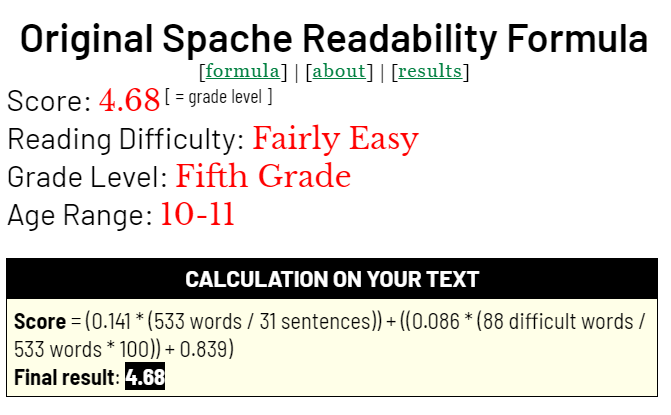
Dr. George Spache later tweaked his formula to this:
The score indicates the grade level needed to comprehend the text. For instance, a Spache score of 4.6 suggests the text is appropriate for a student in 4-5th grade.
Educators rely on the Spache formula for:
a) Simplicity: Its straightforward calculation method—relying on familiar words and sentence length—makes it user-friendly for teachers and administrators.
b) Quick Assessment: The formula provides rapid evaluations of text complexity, allowing educators to efficiently match reading materials.
c) Grade-level Matching: By focusing on familiar words at specific grade levels, the Spache formula ensures that texts align with students’ reading abilities.
d) Positive Impact: Studies have shown that when educators use the formula to select appropriate materials, students demonstrate enhanced reading comprehension and fluency.
Like many readability formulas, Spache has some downsides:
a) Lack of Context: The formula does not account for the context or content of a text, which can influence its overall difficulty.
b) Vocabulary Diversity: It may not fully capture the diversity of vocabulary used in certain texts, as it primarily focuses on common words.
c) Limited Linguistic Factors: The formula relies on word frequency and sentence length, omitting other linguistic aspects that contribute to readability.
d) Language-specificity: The formula was initially developed for English texts and may not be as accurate when applied to texts in other languages.

Spache vs. Dale-Chall Readability Formula
Spache is similar to the Dale-Chall Readability Formula. While Spache was designed to score primary texts through the end of 3-4th grade, The Dale-Chall is ideal to score more advanced texts -i.e., fourth grade and above. Which formula should you use, and when?
1. If your text sample is equivalent to a 3-4th grade text or below, use the Spache.
2. If your text sample is more advanced than third grade, use the Dale-Chall.
3. If you are not sure about the passage’s difficulty, first use the Spache formula. If the Spache results are higher than fourth grade, run the same passage again with the Dale-Chall.
| Aspect | Spache Formula | New Dale-Chall Formula |
|---|---|---|
| Purpose | Estimates reading difficulty for children | Estimates reading difficulty for children |
| Word Difficulty Criteria | Predefined list suitable up to 4th grade | Larger list suitable for 4th grade and above |
| Sentence Length | Average number of words per sentence | Average sentence length and percentage of difficult words |
| Target Age Group | Up to 4th grade | Wider range, including upper elementary and secondary education |
| Complexity/Accuracy | Simpler, limited scope | More accurate for a broader range of texts |
| Historical Context | Developed in the 1950s, later revised | Updated version with revised word list |
| Formula Structure | Straightforward with fewer variables | More complex with nuanced text evaluation |